Key Takeaways
- Dividend investing is a strategy of buying shares in companies that regularly pay out dividends — creating passive income. This guide explains what dividends are, how dividend yield and payout ratio work, the best dividend stocks in India, and how to build a dividend portfolio.
What is Dividend Investing?
Dividend investing is a strategy focused on buying shares of companies that regularly distribute a portion of their profits to shareholders as dividends. The goal is to generate passive income in addition to capital appreciation.
What is a Dividend?
A dividend is a payment made by a company to its shareholders from its profits. In India, dividends are typically paid annually or semi-annually, though some companies pay quarterly.
Example: If you own 100 shares of a company and it declares a ₹5 per share dividend, you receive ₹500.
Key Dividend Metrics
Dividend Yield
Formula: Dividend Yield = (Annual Dividend per Share / Current Stock Price) × 100
Example: Stock at ₹500, annual dividend ₹20 → Yield = 4%
A yield of 2–5% is generally considered good in India. Very high yields (8%+) can signal the stock price has fallen significantly or the dividend is unsustainable.
Dividend Payout Ratio
Formula: Payout Ratio = (Dividends Paid / Net Profit) × 100
A payout ratio of 30–60% is healthy — the company retains enough profit for growth while rewarding shareholders. Above 80% may be unsustainable. Some high-yield sectors (PSU banks, utilities) may have higher ratios.
Ex-Dividend Date
You must own the stock BEFORE the ex-dividend date to receive the declared dividend. If you buy on or after the ex-date, you won't get that dividend payment. The stock price typically drops by approximately the dividend amount on the ex-date.
Best Dividend Stocks in India (2026)
Some of the consistent high dividend-paying companies in India include:
- Coal India: One of the highest dividend payers (PSU)
- Vedanta: High dividend yield (though debt-heavy)
- ITC: Consistent dividends with stable FMCG business
- ONGC: Government-mandated high dividends
- Power Grid Corporation: Stable utility dividends
- HDFC Bank: Consistent moderate dividends with growth
Dividend Reinvestment (DRIP)
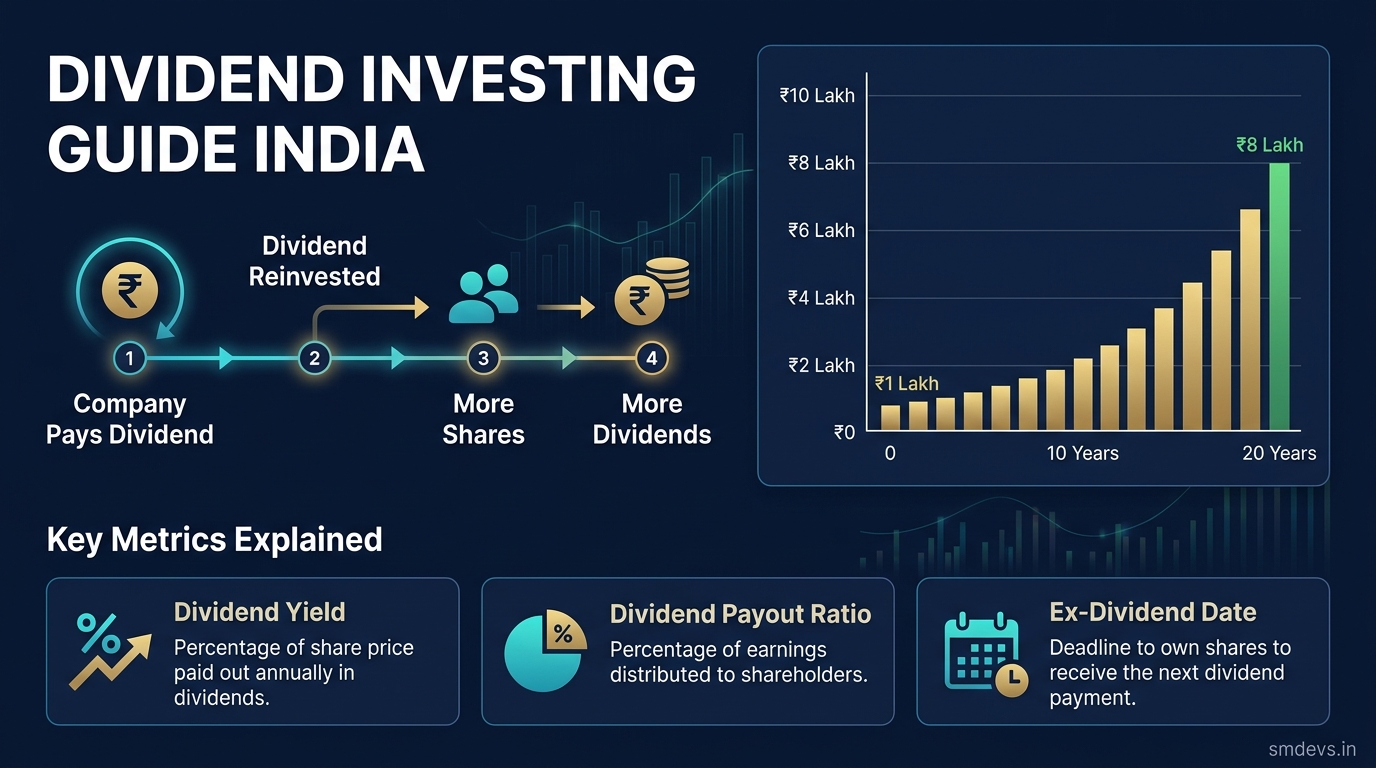
Dividend Reinvestment Plans (DRIP) involve automatically reinvesting dividends to buy more shares. This creates a compounding effect:
- More shares → More dividends → More shares → More dividends
- Starting with ₹1 lakh at 4% yield + reinvestment + 8% price growth = ~₹8 lakh in 20 years
The power of DRIP is why Warren Buffett and other value investors hold dividend stocks for decades.
Dividend Investing Strategy for India
Focus on Dividend Growth, Not Just Yield
A stock growing its dividend 10% annually is better than a stock with a static 8% yield. In 10 years, the growing dividend company will pay more per share.
Check Dividend History
Look for companies that have paid dividends consistently for 10+ years and haven't cut them during downturns. This indicates financial stability.
Sector Diversification
Diversify across sectors: PSU banks, utilities, FMCG, IT (modest but growing dividends), oil & gas.
Tax on Dividends in India
As of 2020, dividends in India are taxed as per your income tax slab (not the earlier DDT system). If you're in the 30% tax bracket, dividends are taxed at 30% + surcharge + cess. TDS of 10% is deducted if annual dividend exceeds ₹5,000.