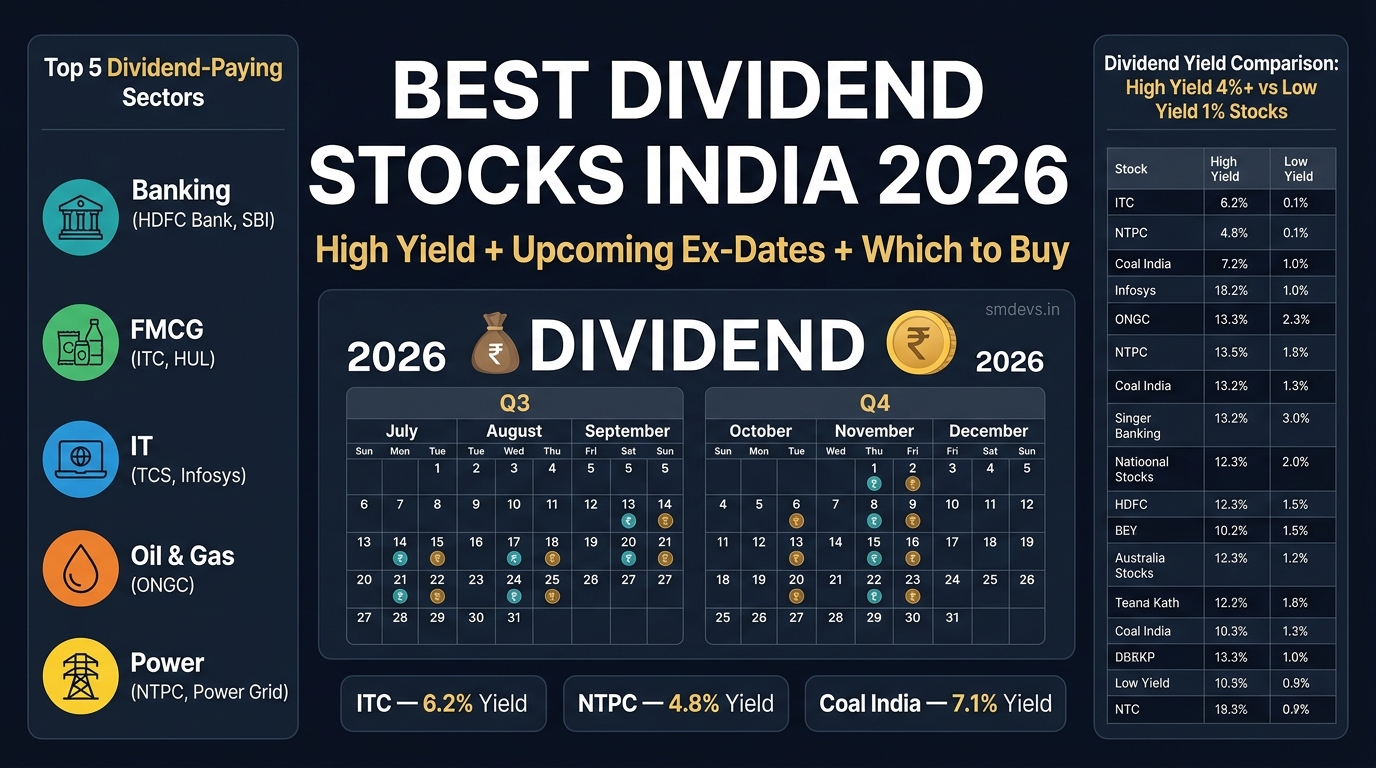
Key Takeaways
- Dividend investing is one of the most underrated wealth-building strategies in India. While most retail investors chase multibaggers and F&O profits, a disciplined dividend portfolio quietly generates
What Is a Dividend and Why Does It Matter?
A dividend is a portion of a company's profit distributed to its shareholders. When you hold a stock on or before its ex-dividend date, you receive the dividend — regardless of whether the stock price goes up or down.
Key dividend terms:
- Dividend Yield: Annual dividend per share ÷ Current share price × 100. Example: ITC pays ₹6.50/share annually. At ₹460, yield = 1.41%.
- Ex-Dividend Date (Ex-Date): You must OWN the stock BEFORE this date to receive the dividend. Buy on or after this date = no dividend for this cycle.
- Record Date: The date the company checks its register to identify eligible shareholders (typically 1 day after ex-date in India's T+1 settlement system).
- Dividend Payout Date: When the dividend is actually credited to your demat account (usually 2–4 weeks after record date).
How to Evaluate Dividend Stocks: Quality vs Yield
A common mistake is chasing the highest dividend yield without checking sustainability. A 12% dividend yield is useless if the company cuts the dividend next quarter.
5 Metrics to Check Before Buying a Dividend Stock
- Dividend Payout Ratio = Dividend per share ÷ EPS × 100. Ideal range: 30–60%. Above 80% suggests the company is paying more than it can sustainably afford.
- Dividend Consistency: Has the company paid dividends every year for the last 5–10 years without missing or cutting? Check BSE/NSE corporate actions history.
- Free Cash Flow: Dividends are paid from cash, not accounting profit. A company with strong free cash flow can sustain dividends even in tough years.
- Debt levels: Highly indebted companies may cut dividends during downturns to service debt. Prefer low-debt dividend payers.
- Dividend Growth: A company growing its dividend per share by 10–15% annually is far more valuable than one paying a static high yield. PSUs like NTPC and Coal India have shown dividend growth in recent years.
Top Dividend-Paying Stocks in India 2026
Category 1: High Yield (4%+ Annual Dividend Yield)
| Stock | Sector | Approx. Dividend Yield | Notes |
|---|---|---|---|
| Coal India (CIL) | Mining/Energy | 6–8% | Highest dividend yield among large-caps; PSU; strong FCF from coal monopoly; declared ₹5–7/share interim dividends regularly |
| ONGC | Oil & Gas | 4–5% | PSU oil major; volatile earnings but committed to high payouts per government dividend policy; interim + final dividends |
| NTPC | Power | 3.5–5% | India's largest power producer; stable cash flows; growing dividend per share every year; defensively positioned |
| Power Grid Corporation | Power Transmission | 4–5% | Regulated revenue model; one of the most consistent dividend payers on NSE; low-risk infrastructure play |
| Vedanta | Metals & Mining | 8–12% (variable) | Pays very high dividends but is highly cyclical and debt-heavy — yield attractive but sustainability risk exists |
Category 2: Moderate Yield + Dividend Growth (2–4% Yield)
| Stock | Sector | Approx. Yield | Notes |
|---|---|---|---|
| ITC | FMCG / Cigarettes | 2.5–3.5% | Extremely consistent; growing dividend per share; diversifying beyond cigarettes; strong FCF; hotel + paper + FMCG segments growing |
| Infosys | IT | 2.5–3.5% | Returns cash via dividends + buybacks; consistent quarterly + special dividends; financially very strong |
| TCS | IT | 1.5–2.5% | Pays regular + special dividends; world-class balance sheet; one of the most shareholder-friendly large-caps in India |
| HCL Technologies | IT | 3–4% | Higher yield than TCS/Infosys; pays quarterly dividends; growing services business |
| Hindustan Zinc | Metals | 5–8% | Vedanta group; high yield but follows Vedanta's cyclical dividend policy; strong zinc business fundamentals |
Category 3: PSU Banks with Growing Dividends
| Stock | Approx. Yield | Notes |
|---|---|---|
| State Bank of India (SBI) | 1.5–2.5% | Growing dividend; large PSU; improved NPA situation; government committed to maintaining payouts |
| Bank of Baroda | 2–3% | Improved profitability; increasing dividend per share; lower NPA vs peers |
| Canara Bank | 2.5–3.5% | High ROE PSU bank; growing dividend track record |
How to Track Upcoming Ex-Dividend Dates
To receive dividends, you need to buy shares BEFORE the ex-date. Here's how to track upcoming ex-dates:
- BSE Corporate Announcements: bseindia.com → Corporate Filings → Dividends — search by company or date range. BSE lists ex-dates for all listed companies.
- NSE Corporate Announcements: nseindia.com → Corporate Announcements → Dividends — same information from NSE side.
- Screener.in: Filter stocks by dividend yield and check dividend history for any company.
- Tickertape / Trendlyne: Both platforms aggregate upcoming ex-dates in a calendar view — very useful for planning.
- Your broker app: Zerodha Kite, Upstox, Angel One — all send notifications for stocks in your watchlist approaching ex-dates.
Important: In India's T+1 settlement system (implemented since Jan 2023), you need to buy shares at least 1 day before the ex-date to receive the dividend. If the ex-date is Tuesday, buy on Monday or earlier.
Dividend Investing Strategy: How to Build a Portfolio
Strategy 1: High-Yield Income Portfolio (4%+ average)
For investors seeking regular income (retired individuals, those wanting passive cash flow):
- 60% allocation to high-yield, stable PSUs: Coal India, NTPC, Power Grid, ONGC
- 20% to IT dividend growers: HCL Tech, Infosys
- 20% to FMCG/Consumer: ITC, Hindustan Unilever (lower yield but dividend growth)
This portfolio targets approximately 4–5% average dividend yield — equivalent to many fixed deposits — but with the additional potential for capital appreciation.
Strategy 2: Dividend Growth Portfolio (2–3% yield but 15%+ annual dividend growth)
For long-term wealth builders: Focus on companies growing their dividend per share at 15%+ annually. At this growth rate, a 2% yield on your purchase price becomes 4%+ in 5 years and 8%+ in 10 years — even without any share price appreciation. Companies with this track record in India: TCS, Infosys, HDFC Bank (historically), Asian Paints, Pidilite.
Tax on Dividends in India
Since FY2020–21, dividends are taxable in the hands of the investor (not the company). Dividends are added to your income and taxed at your applicable income tax slab rate:
- TDS at 10% is deducted at source if annual dividends from a single company exceed ₹5,000
- If you're in the 30% tax bracket, you pay 30% on dividends — making high-yield dividend stocks less attractive than they appear on pre-tax yield numbers
- For tax-efficiency, SIP in growth option mutual funds (which reinvest dividends and don't distribute them) may be preferred in high-bracket investors
FAQs: Dividend Stocks India
Which Indian stock gives the highest dividend?
As of 2026, Coal India consistently offers among the highest dividend yields (6–8%) among large-cap Indian stocks, followed by Vedanta (8–12% variable), Power Grid (4–5%), NTPC (4–5%), and ONGC (4–5%). However, Vedanta's high yield carries sustainability risk due to high corporate debt. For consistent high yield, Coal India and Power Grid are more reliable.
What is ex-dividend date and why does it matter?
The ex-dividend date is the first date on which a new buyer of a stock is NOT entitled to the upcoming dividend. To receive a dividend, you must hold the stock BEFORE the ex-date. In India's T+1 settlement system, you need to purchase at least 1 trading day before the ex-date for your ownership to be confirmed in time.
Is dividend income taxable in India?
Yes — since FY2020–21, dividends are taxable in India as "Income from Other Sources" at the recipient's applicable income tax slab rate. TDS at 10% is deducted by the company if total dividends from that company exceed ₹5,000 in a financial year. Higher-income investors (30% bracket) should factor in post-tax dividend yield when comparing dividend stocks to other investments.