Key Takeaways
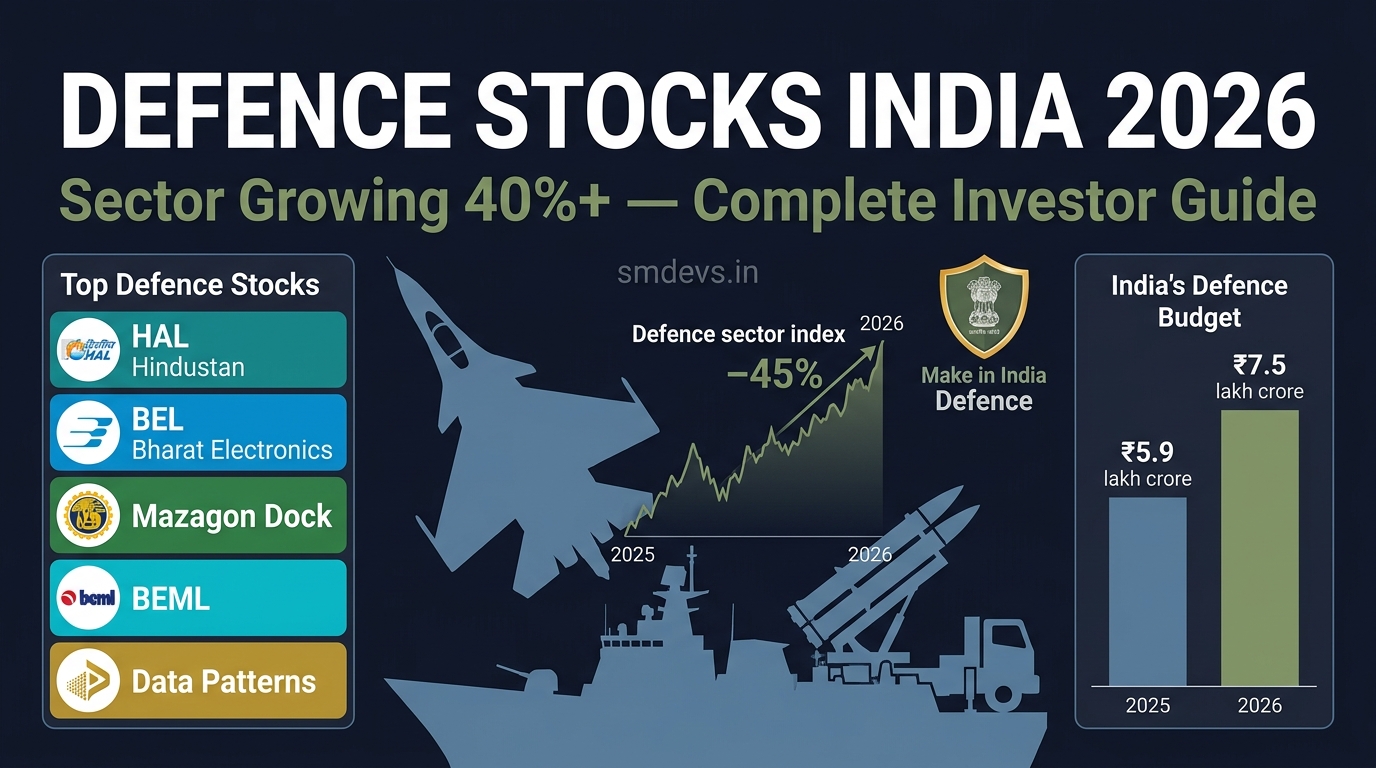
- India's defence sector is undergoing the most significant transformation in its history. With a defence budget exceeding ₹6.2 lakh crore in FY2026 and an ambitious goal of ₹3 lakh crore in domestic de
Why India's Defence Sector Is a Golden Decade Opportunity
Three structural forces are converging to make India's defence sector one of the most compelling multi-year investment themes:
1. Massive and Growing Budget
India's defence budget for FY2026 stands at approximately ₹6.2–6.8 lakh crore — one of the largest in Asia and growing at 8–12% annually. Crucially, the capital expenditure portion (procurement of weapons, aircraft, ships, electronics) has grown faster than the revenue portion, directly benefiting listed defence manufacturers.
2. Import Substitution — The Make in India Tailwind
India has historically been one of the world's largest defence importers — spending billions on fighter jets, missiles, submarines, and electronics from Russia, France, Israel, and the US. The government has now published a "Positive Indigenisation List" (PIL) — 509+ items that India will no longer import and must procure domestically. Each item on this list is a direct revenue opportunity for Indian defence manufacturers.
The target: India aims to achieve ₹3 lakh crore in annual domestic defence production and ₹50,000 crore in exports by 2030 — up from approximately ₹1.5 lakh crore production and ₹21,000 crore exports in FY2024.
3. Geopolitical Reality
Post-2020 (Galwan Valley clash), India has permanently increased its defence spending and modernisation pace. The Russia-Ukraine war also reinforced for India that over-reliance on any single foreign supplier is a strategic vulnerability — accelerating indigenisation further.
Top Defence Stocks in India 2026 — Analysis
1. HAL — Hindustan Aeronautics Limited
What it does: India's premier aerospace and defence company — designs, develops, and manufactures military aircraft, helicopters, and aero-engines. A Navratna PSU under the Ministry of Defence.
Key products/programs:
- Tejas Light Combat Aircraft (LCA) — IAF has ordered 83 Mk1A and is evaluating 97 more Mk2 jets
- Advanced Light Helicopter (ALH Dhruv) — supplied to Army, Navy, Coast Guard
- LCH Prachand (Light Combat Helicopter) — recently inducted into IAF
- Maintenance of Sukhoi Su-30 MKI fleet
- HTT-40 basic training aircraft
Order book: HAL's order book exceeds ₹1 lakh crore — visibility 5–7 years of revenue. This is the gold standard for defence stocks.
Risk: Execution delays are common; delivery timelines are frequently extended. Revenue recognition can be lumpy.
2. BEL — Bharat Electronics Limited
What it does: India's leading defence electronics company — manufactures radar systems, communication equipment, electronic warfare systems, sonar, night vision devices, and space-related electronics.
Key advantage: As modern warfare becomes increasingly "electronics-heavy" (precision-guided munitions, drone warfare, cyber-electronic warfare), BEL's market directly expands. India's push for domestic radar systems and electronic warfare capabilities makes BEL indispensable.
Order book: BEL maintains a robust order book of ₹70,000–80,000 crore+ with high-margin products and technology products. Consistently pays dividends (yield 1–2%).
Civil segment: BEL also has a growing civilian segment (EVM machines, Metro rail communication, smart city infrastructure) — reduces pure defence cyclicality.
3. Mazagon Dock Shipbuilders (MDL)
What it does: India's premier naval shipbuilder — constructs destroyers, frigates, submarines, and other naval vessels for the Indian Navy.
Key programs:
- Project 75: Building 6 Scorpene-class submarines (completed 5, 6th awaited)
- Project 75I: India's next-generation indigenous submarine program — massive opportunity
- P15B destroyers and P17A stealth frigates for the Navy
India's naval expansion: India is the world's 3rd largest navy and actively expanding — targeting 200 warships by 2027 (currently ~150). Each major warship costs ₹5,000–15,000 crore. Mazagon Dock has a near-monopoly on submarine construction.
Valuation: Has seen significant re-rating (P/E expansion) as market recognised the order book quality. Monitor valuations carefully — the stock has priced in significant growth already.
4. BEML Limited
What it does: Heavy equipment manufacturer for defence (mining vehicles, gun towing trucks, bridge-laying tanks), metro rail cars, and aerospace ground equipment.
Opportunity: Government's push for Vande Bharat trains and metro expansion + defence vehicle indigenisation creates dual revenue streams. BEML is one of the few companies with both infrastructure and defence exposure.
5. Data Patterns (India) — The High-Growth New-Age Pick
What it does: Designs and manufactures defence and aerospace electronics — radar signal processing, avionics, sonar systems, electronic warfare subsystems. A private sector, technology-intensive defence company.
Why it's interesting: Unlike PSUs (HAL, BEL, Mazagon), Data Patterns is a private company — leaner, faster, higher margins (EBITDA 28%+). It develops IP-intensive products, not just assembles. Growing at 30%+ revenue CAGR.
Risk: Valuation is demanding (high P/E); smaller order book than PSU peers; execution risk as a smaller company. But arguably offers the best growth profile in the sector.
Defence Sector Risks to Monitor
- Execution delays: Defence contracts are complex. HAL's Tejas delivery has been delayed multiple times. Revenue recognition gets pushed, impacting near-term earnings.
- Valuation risk: Many defence stocks have seen massive re-rating — P/E multiples of 50–100x+ are priced in a lot of future growth. Any earnings disappointment can cause sharp corrections.
- Government policy changes: Budget cuts or policy shifts can directly impact order flows. While structural growth is clear, individual budget cycles matter.
- Competition**: Private sector entries (L&T Defence, Tata Advanced Systems, Adani Defence) are creating more competition for government contracts.
How to Invest in Defence Sector Stocks
Option 1: Individual Stock Picking
Buy HAL, BEL, Mazagon Dock directly on NSE/BSE through your broker. Research order books, execution track record, and valuations carefully before investing.
Option 2: Defence Sector Mutual Funds / ETFs
- HDFC Defence Fund: A dedicated defence sector fund investing across the defence value chain
- Motilal Oswal BSE Defence ETF: Tracks the BSE India Defence Index — diversified exposure to the entire sector
- ICICI Prudential BSE Defence Index Fund: Passive fund tracking the defence index
Sector funds are higher risk than diversified equity funds — suitable only for investors who specifically want concentrated defence exposure.
FAQs: Defence Stocks India
Is it good to invest in defence stocks in India in 2026?
The structural case for Indian defence stocks remains compelling — growing budget, import substitution mandate, geopolitical tailwinds, and a multi-decade indigenisation programme. However, many defence stocks have already delivered 2–5x returns in 2–3 years and valuations are elevated. New investors should invest gradually (SIP style) rather than lump-sum, and maintain a 5+ year investment horizon. These are long-gestation, lumpy-earnings businesses.
Which is the best defence stock in India?
HAL offers the largest order book and most direct play on India's airpower expansion (Tejas + helicopters). BEL is the most consistent dividend payer with the broadest defence electronics portfolio. Mazagon Dock holds a near-monopoly on submarine construction — a high-moat position. Data Patterns offers the best growth profile among private-sector defence names. The "best" depends on your risk appetite and investment horizon.
Is there a defence sector ETF in India?
Yes — Motilal Oswal BSE Defence ETF (listed on NSE) tracks the BSE India Defence Index, which includes HAL, BEL, Mazagon Dock, BEML, Cochin Shipyard, Data Patterns, and other defence names. It provides diversified exposure without the risk of single-stock concentration. ICICI Prudential and Mirae Asset also have passive defence index funds.